Why a light plush can cost more to ship
Dimensional weight, or DIM weight, converts a parcel’s volume into a pricing weight. Carriers compare this weight with the actual packed weight. The higher figure usually sets the base billable weight. A bulky plush in a large carton can therefore cost more than its scale reading suggests.
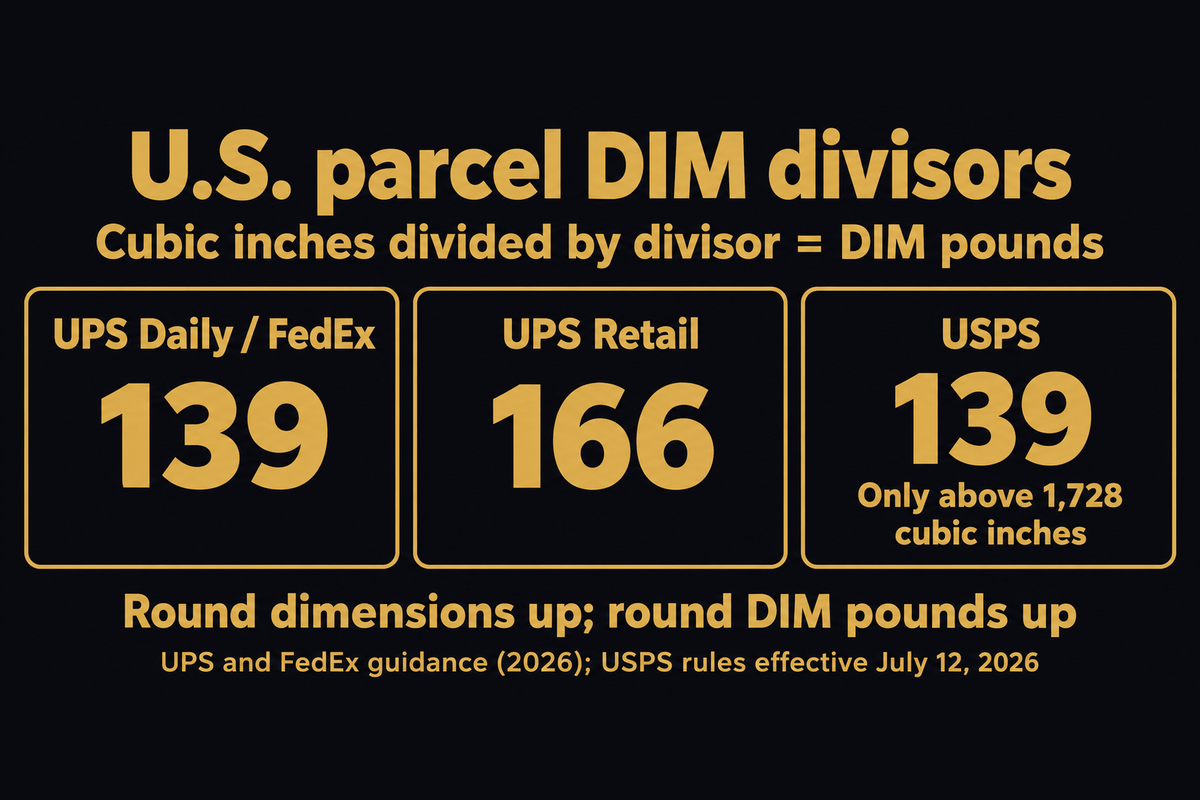
UPS distinguishes rate types: its U.S. guidance lists a divisor of 139 for Daily Rates and 166 for Retail Rates. FedEx uses 139. USPS changed its divisor to 139 on July 12, 2026. For rectangular USPS parcels, DIM applies only above one cubic foot, or 1,728 cubic inches. These are pricing rules, not the toy’s physical weight.
Sources: UPS Package Dimensions, Size Limits and Weight Guide (checked 2026); FedEx Service Guide (2026); USPS Postal Bulletin 22705 (2026).
Free box comparison
Dimensional-weight calculator
Enter the sealed box’s outside measurements and total weight. Add a smaller box to compare. Both boxes use the same actual weight, so weigh the final package again after repacking.
| Carrier / rate | DIM current → smaller | Billable current → smaller | Reduction |
|---|
Method: convert centimeters to inches using 2.54 cm per inch, then round each side up. Divide volume by the carrier divisor and round DIM pounds up. Compare with actual pounds rounded up. This tool covers weights from 1 to 70 lb. USPS uses actual weight at or below 1,728 cubic inches and caps DIM pricing at 70 lb. Sources: NIST SP 811 (2008), UPS guidance (checked 2026), FedEx Service Guide (2026), USPS DMM 133 (2026).
Results show base weight reductions, not dollar savings. They exclude Flat Rate, cubic pricing, negotiated divisors, special minimum weights, and surcharges. Size limits still apply. Check the carrier quote before buying a label.
What a smaller box changes
Consider an example with a packed weight of 2 lb. An 18 × 14 × 12 inch box has 3,024 cubic inches. Dividing by 139 gives 21.76, which rounds up to 22 lb. UPS Retail uses 166, so its DIM weight rounds up to 19 lb.
A 14 × 10 × 8 inch box has 1,120 cubic inches. UPS Daily and FedEx fall to 9 lb; UPS Retail falls to 7 lb. USPS falls to the actual 2 lb because this box is below its DIM threshold. The respective base weight reductions are 13, 12, and 20 lb. These calculated examples do not promise a particular postage discount.
Pack the plush before choosing the box
Use this packing sequence as a practical application of FedEx’s packaging guidance, checked in 2026. FedEx recommends matching packaging to an item’s size and fragility. Its clothing guide recommends an inner bag to help protect fabric from dirt and moisture.
- Check the toy’s own care instructions. Inspect rigid eyes, joints, decorations, and tags before you attempt compression.
- Place the dry toy in a clean inner bag. Gently press out spare air if the toy permits it. Stop if parts bend or seams pull.
- Try the bagged toy in a smaller carton. Keep room for protective material around delicate parts. Do not force the flaps closed.
- Seal the carton. Measure its widest outside points, including any bulges. Weigh the toy, bag, carton, tape, and padding together.
Do not assume every plush can tolerate vacuum packing. Check the manufacturer’s instructions before you use a vacuum bag. If the instructions do not address compression, use a box that fits without it. The calculator compares your proposed boxes; it does not assess damage risk.
Measure again before buying postage
A box label may describe its inside dimensions. Use your own outside measurements for this calculation. A rounded-up side can increase the calculated volume, even when the difference looks small. A USPS box exactly at 1,728 cubic inches stays outside DIM pricing; a larger rounded volume crosses the threshold.
Compare available shipping services with the same destination and final package details. A lower billable weight does not guarantee the lowest total price. Keep the packed toy secure, then choose the smallest suitable box.